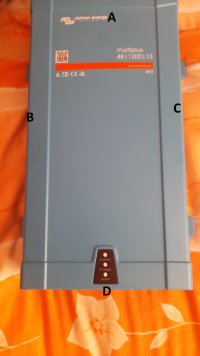
You can generally mount them in any orientation. The biggest thing to make sure of it adequate air flow. Don't block the A or D ends as that's where the air flow moves from/to.
As far as size of fuse, that all depends on your loads all combined, to a point. If you are going to have a primary breaker/fuse right after the inverter, and then have a sub-panel later on that breaks out, then use a breaker that matches the output of the Inverter. If it's rated for 100A, then use a 100A breaker.
If you plan on going directly into a panel and not add more circuits to it later, then go about 20% over your combined loads. So if you have 6 circuits that 2 are 20A and 2 are 10A, then combined you'd have 40A+20A = 60A. Your first breaker would be 60A and then your loads after that.
I personally would have the first breaker be what the Inverter can handle minus about 10A. So if it's rated for 100A, then 90A would be a great way to keep it protected. And then have a secondary sub-main breaker that further protects the branch circuits after that. This way you have triple protection for the whole line.
So, 100A for the main breaker directly connected to the Inverter. Then a 60A sub-panel breaker. Then your smaller load circuits after that.
This way, if you add more major loads, you can easily add another sub-panel breaker box without worry of interfering or overloading the other one.